MUTEC ASTRALIUS - The re-clocking D/A converter for the highest audiophile expectations
In the world of digital music playback, sound quality plays a crucial role. The MUTEC ASTRALIUS is a re-clocking digital-to-analog converter designed to take this sound quality to a whole new level. MUTEC, known for its expertise in precise clocking of digital audio systems, presents the ASTRALIUS, its first D/A converter that combines this experience with a high quality analog output.
Technology and Features
At the heart of the ASTRALIUS is 1G Clock technology and the REVIVE re-clocking algorithm familiar from the MC3+ series. These technologies ensure precise timing and reduce jitter, resulting in clearer, more textured and spacious sound reproduction.
Additional Features
Dual mono architecture with ESS Sabre® DACs for maximum resolution
Supports PCM audio up to 768.0 kHz and DSD512, DoP256
Galvanically isolated and switchable USB interface
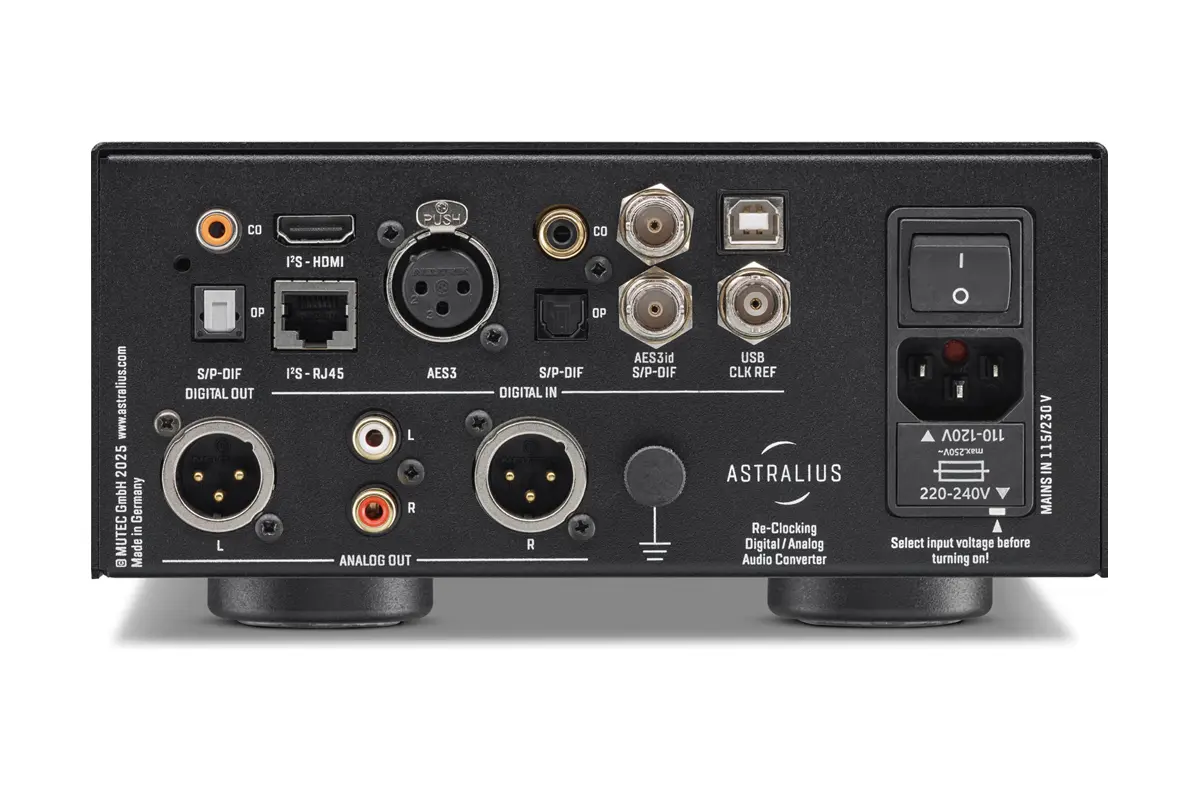
Eight digital inputs (USB, AES/EBU, S/P-DIF, HDMI & RJ45)
10 MHz reference clock input for external clock synchronization
Integrated high-fidelity headphone amplifier with separate volume control
Ultra-low-noise power supply, linear dual power supply and highly efficient mains input filtering
Bilingual, switchable front display
Applications
In high-end stereo systems as a central D/A converter for streamers and CD transports
As an audiophile desktop DAC for the workplace or home office
For optimizing digital sources thanks to re-clocking
In the studio or mobile setup as a precise monitoring DA
Design and Production
The ASTRALIUS features a sophisticated design with clear connection logic. The fully balanced converter architecture is based on two ESS Sabre® DACs in mono mode. The unit is designed and manufactured in Germany.
The MUTEC ASTRALIUS is an uncompromising D/A converter. With its precise clocking, high quality components and versatile application possibilities it is aimed at audiophiles and music lovers who want to get the best out of their digital music.
See and hear it at High End 2025 in Munich. May 15–18, Hall 4 / Booth W02